
Uber Eats and Deliveroo algorithm: how your restaurant is ranked in the app

By Tom Voisin, founder of Deliview Published 5 min read
No commitment.

Do Uber Eats and Deliveroo publish their ranking criteria?
Yes, in broad terms. The algorithm itself stays secret, but Deliveroo has a page called “Classement et référencement de nos partenaires” (how partners are ranked and listed). Uber describes how its apps work in a dedicated document, and sets out in its contract and its score policy what weighs on your visibility.
Neither of them gives its formula: you know the ingredients, not the quantities. Every criterion in this article comes from one of these official pages, listed at the bottom of the page.
How does Deliveroo rank restaurants?
Deliveroo ranks first by how likely a customer is to order from you. To estimate it, its page on ranking looks at three things:
- the customer: their past orders, whether they have already ordered from you, the cuisine they prefer;
- the current order: the time, the expected wait until delivery, the distance between your restaurant and the customer’s address;
- your restaurant: the rating given by this customer and by others, whether it belongs to a chain, and whether it “is currently running a promotion” (translated from French).
Other factors then refine the order: trending cuisines, the availability of your items, and financial considerations for Deliveroo, such as its revenue and its costs.
Paid placements exist too. A restaurant can pay to be featured in certain places in the app, and these placements are marked as sponsored.
What you can change on Deliveroo: your rating, your promotions, your preparation time, which affects the wait, and the availability of your dishes. The distance and the customer’s habits are out of your hands.
How does Uber Eats rank restaurants?
In the page that explains its apps in France, Uber cites “availability” and “the experience of past orders”, such as “the order acceptance rate” (translated from French). Its contract with restaurants also lists price among the ranking criteria.
The most concrete lever is still the Success Score. Uber Eats recalculates it on the 1st of each month, location by location, over the last 28 days. It looks at:
- the reliability of your orders: accepted, ready on time, without errors;
- your menu: the share of your dishes with a photo or a description;
- your customer ratings;
- the markup on your prices;
- depending on the country, your packaging.
The score puts you in one of five tiers. The top tiers give access to promotions and ads, to carousels in the app and to discounts on promotion fees. The top two tiers also open up Top Eats: a badge on your listing, and spots in the sections reserved for the best-rated restaurants.
The bottom tier gives no benefits and can cut off your marketing tools. A restaurant that stays there for several months is contacted by Uber, and then risks being removed from the app.
Which levers count on both platforms?
The two platforms don’t weigh the same things, but five levers keep coming up. The table shows where each one counts, and links to the guide that covers it in detail.
| Lever | Uber Eats | Deliveroo | Our guide |
|---|---|---|---|
| Customer rating | In the Success Score | Ranking criterion | Improve your rating |
| Orders ready on time, without errors | In the Success Score | The expected wait is a criterion | Handle the rush |
| Opening and availability | Criterion cited by Uber | Item availability | Restaurant closed mid-service |
| Photos and descriptions | In the Success Score | Not cited | Dish photos |
| Prices | Contract criterion, markup in the score | High markups flagged to customers | Set your prices |
| Promotions | Access depends on your score | Ranking criterion | A profitable promotion |
On Deliveroo, the markup on your prices is not one of the published ranking criteria. But the platform measures the gap between your prices in the app and in your restaurant, and makes high markups visible to customers. Our article on the Deliveroo commission covers this point in detail.
Real example: what a listing shows in thirty seconds
Here is a burger restaurant in Paris, analysed by Deliview on 2 October 2026 (name anonymised).
- On Uber Eats: 8th of 14 by rating in its area, with 4.2 against an average of 4.1. No promotion, while 10 of its 14 competitors have one. Prices 52% above those of its area.
- On Deliveroo: 4th of 8 by rating, with 4.3, the same as the average. No promotion, while 4 of its 9 competitors have one. Prices 30% above its area.
Its rating is average: that is not what holds it back. The gaps are elsewhere: no promotion, even though Deliveroo takes promotions into account, and prices well above its neighbours’. Two levers to test first, not twenty.
Which mistakes cost you places?
Paying for ads before sorting out your rating and reliability. On Uber Eats, a score that is too low can cut off your access to promotions and ads. Paid visibility doesn’t make up for rejected orders.
Running promotions on services that are already full. A promotion counts in Deliveroo’s ranking, but it costs you on every order. Keep it for your quiet hours: our article on profitable promotions gives the calculation.
Raising all your prices at once to cover the commission. Uber Eats tracks your markup in its score, and Deliveroo flags high markups to customers. Raise them dish by dish, comparing yourself with your area: see how to analyse your competitors’ prices.
Letting the tablet pause itself mid-service. A closed restaurant receives no orders, and Uber cites availability among its ranking criteria.
Believing tips that have no source. If a method doesn’t rest on any rule published by the platform, test it for two weeks before you believe in it.
How do you track your ranking?
In Uber Eats Manager, you see your targets for each criterion of the Success Score, and you know where you stand before the 1st of the month. In Deliveroo’s Partner Hub (“Portail Partenaire” in French), your ratings are in their own section.
What neither tool shows is where you stand against the restaurants in your area. For that, note down the rating, the promotions and a few prices of five to ten competitors every week, on both platforms.
Deliview does this check for you: your rating and your rank in your area, on Uber Eats and Deliveroo, with your neighbours’ promotions and the price gap dish by dish.
In Deliview
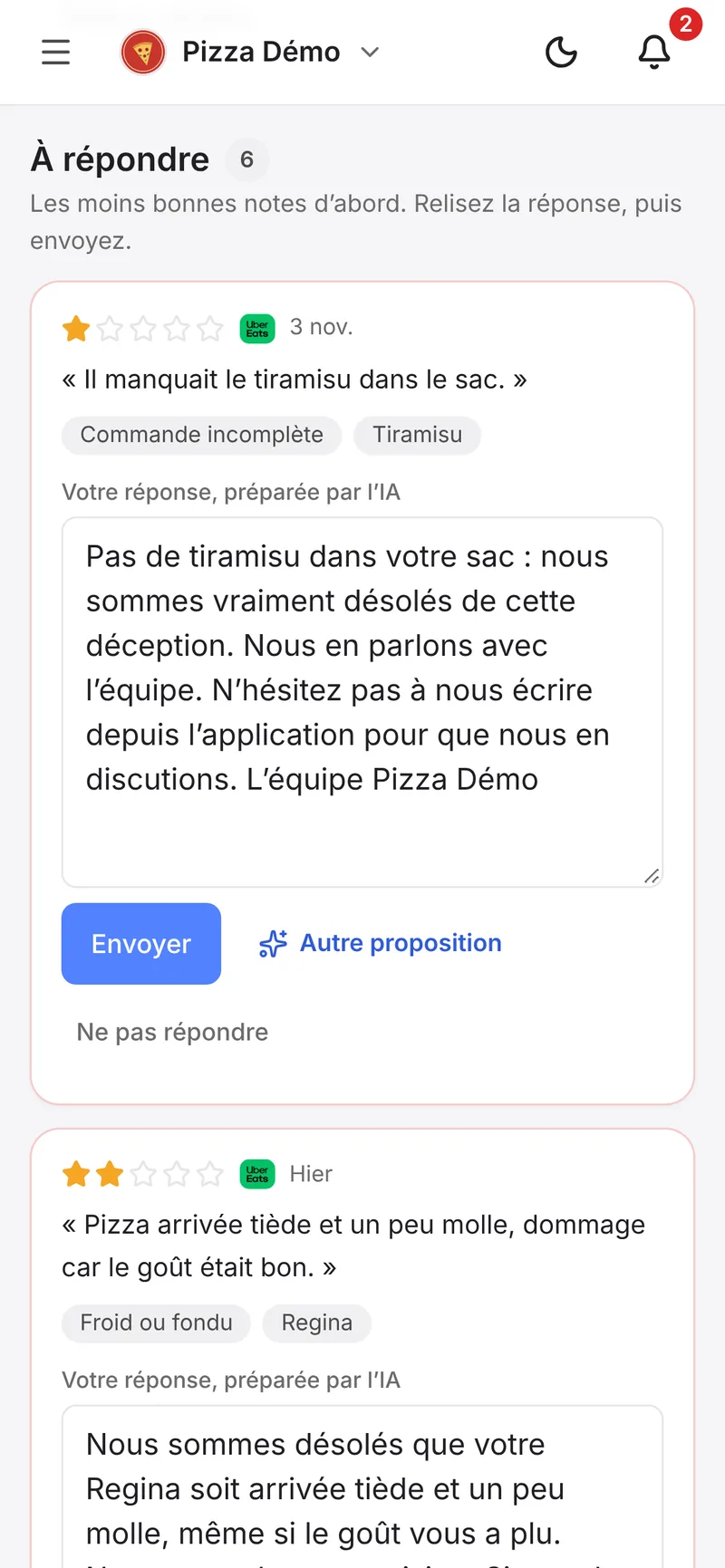
A reply ready for every review
Deliview brings your Uber Eats and Deliveroo reviews together. For each one, the AI prepares a reply in the restaurant’s name: you read it, you send it.
Sources
- Classement et référencement de nos partenaires, Deliveroo, accessed 7 October 2026.
- Success score (France), Uber, accessed 7 October 2026.
- Top Eats (France), Uber, accessed 7 October 2026.
- Politique de Score de Réussite Partenaire - Restaurants Partenaires, Uber, accessed 6 October 2026.
- How the Uber and Uber Eats Apps and Websites Work (version française, modifiée le 6 juillet 2026), Uber, accessed 6 October 2026.
- Conditions complémentaires Uber Eats pour les Partenaires (France, applicables depuis le 1er septembre 2026), Uber, accessed 6 October 2026.
- How to manage your restaurant with Uber Eats Manager, Uber, accessed 7 October 2026.
- Transparence des prix sur Deliveroo : Prix Vérifiés et visibilité des majorations élevées (France), Deliveroo, accessed 6 October 2026.
- Où puis-je voir mes notes ?, Deliveroo, accessed 6 October 2026.


