
Improving your rating on Uber Eats and Deliveroo: how it is calculated and what to fix

By Tom Voisin, founder of Deliview Published Updated 7 min read
No commitment.
How do Uber Eats and Deliveroo calculate your rating?
Both platforms average the stars, from 1 to 5, that your customers give after their order. They give priority to recent ratings and show nothing until you have 10 ratings.
| Point | Uber Eats | Deliveroo |
|---|---|---|
| Who rates | The customer, from 1 to 5 stars, after each order | The customer, from 1 to 5 stars, once the order has been delivered |
| Ratings counted | Those from the last 91 days, according to the French legal page (2022) | The last 400 ratings |
| Display | From 10 ratings | From 10 rated orders |
| What the customer sees | The average rating; comments stay private, except the “stories” of regular customers | Ratings, reviews from newest to oldest, tags and the breakdown of ratings |
Uber’s pages don’t all describe the same method: its legal page talks about the last 91 days. Its help centre mentions an average, “with priority given to the most recent ratings” (translated from French). A FAQ for merchants describes a weighted average that favours the last 90 days. Either way, your last three months count the most.
On Deliveroo, a bad rating stays in your average until 400 more recent ratings push it out. At 100 ratings a month, that takes four months. When you have few ratings, each one weighs heavily. Simplified example, as a plain average: with 20 ratings of 4.5, a single 1-star rating drops the average to 4.33.
Why your rating weighs on your sales
At Deliveroo, “the higher your rating, the higher you will appear in the first results of the list in the app” (translated from French). A good rating also helps your “Score Confiance” (trust score) move up to “Bon” (good) or “Excellent”. At Uber Eats, “Notes des Clients” (customer ratings) are part of your location’s Success Score. An insufficient score can restrict your access to the promotion and ad tools, the ones you use to run a profitable promotion.
What brings your rating down?
Both platforms point to the same causes: missing or wrong dishes, preparation delays and packaging. Most of them can be fixed with a simple method, from your very next service.
Deliveroo titled one of its guides “How to avoid missing or incorrect items to reduce refunds and protect your ratings” (translated from French). It cites as frequent causes stock or menus that are not up to date, the lack of an area dedicated to preparation, and unsealed bags. Its help page on order ratings advises finishing dishes for the scheduled pick-up time and not forgetting any product. It asks for packaging that “keeps the heat in well and lets moisture out” (translated from French).
At Uber Eats, the Success Score tracks the order error rate and the time couriers wait because of late preparation. It also tracks satisfaction with the taste and quality of the dishes. According to an Uber FAQ, the best-rated restaurants “accept orders quickly and carefully check the details of each order” (translated from French). Uber Eats also advises keeping your inventory up to date and packing orders to avoid “breakage or leaks” (translated from French).
The steps drawn from these pages:
- update your out-of-stock items before every rush, on both tablets;
- tick off each item on the ticket before closing the bag;
- seal each bag and attach together the bags from the same order;
- write the number of items on the bag;
- switch to “Mode occupé” (busy mode) on the Deliveroo tablet when orders flood in.
To keep up these habits mid-service, see how to manage the Uber Eats and Deliveroo tablets during the rush.
Should you reply to reviews?
Yes, and both platforms let you. The customer is notified by email.
On Uber Eats, open Uber Eats Manager, the “Commentaires” (feedback) tab, then “Avis” (reviews), and click “Répondre” (reply). You can attach a promo code. Reviews can’t be deleted, either by you or by support. Uber Eats Manager can also send a reply written in advance, depending on the number of stars and the type of customer, or even a minimum order amount.
On Deliveroo, reply from the Partner Hub (“Portail Partenaire” in French), in the “Avis et notes” (reviews and ratings) section. Your reply stays private: it goes out by email and doesn’t appear in the app. Deliveroo reads it before it is sent, and you have 30 days to reply. You can add a voucher, invoiced with the wording “Bon de réduction à payer par le restaurant” (discount voucher payable by the restaurant).
According to Deliveroo, customers are “23% more likely to order from you if you interact with them” (translated from French). A good reply names the precise problem, apologises if the mistake was yours and says what you are changing. Deliveroo may refuse replies that invite customers to order elsewhere or directly, and those that put the blame on the rider. For the most common cases in delivery, see our examples of replies to a negative review.
Finally, on Deliveroo, report reviews that break the rules, using the three dots next to the review. The platform removes, for example, reviews focused on the delivery or on situations “beyond the restaurant’s control” (translated from French).
What should you never do?
Post fake reviews or buy them. In France, it is a criminal offence, and Deliveroo removes reviews that are not genuine.
The DGCCRF, the French consumer protection authority, points out that fake positive reviews posted “on the initiative of the business” “constitute the offence of misleading commercial practices” (translated from French). The law on misleading practices also covers “publishing, or having another legal entity or individual publish, fake reviews” (translated from French). The penalty: two years’ imprisonment and a €300,000 fine, which can be raised to 10% of average annual turnover. Since 12 May 2024, the penalty rises to five years in prison and a €750,000 fine when the practice goes through the internet. That is the case for an online review (article L132-2 of the French Consumer Code).
Deliveroo’s rules point the same way. They forbid posting reviews of your own restaurant, or asking your employees, friends or family for them. They also forbid offering payment, a discount or a voucher “in exchange for reviews”, and asking for a negative review to be removed. Reviews published in breach of these rules are removed and “will no longer count towards your partner rating” (translated from French).
A gesture after a review is still allowed: Deliveroo allows a voucher for customers “on an exceptional basis, after they have left a review” (translated from French). Uber Eats also lets you attach a promo code to your reply. The gesture responds to a review that has already been published: it doesn’t buy it. If you are unsure about a practice, ask a lawyer for advice.
How do you know if your rating is good?
Compare it with the ratings of the restaurants that deliver to your area, not with an ideal number. Customers choose from the restaurants shown at their address.
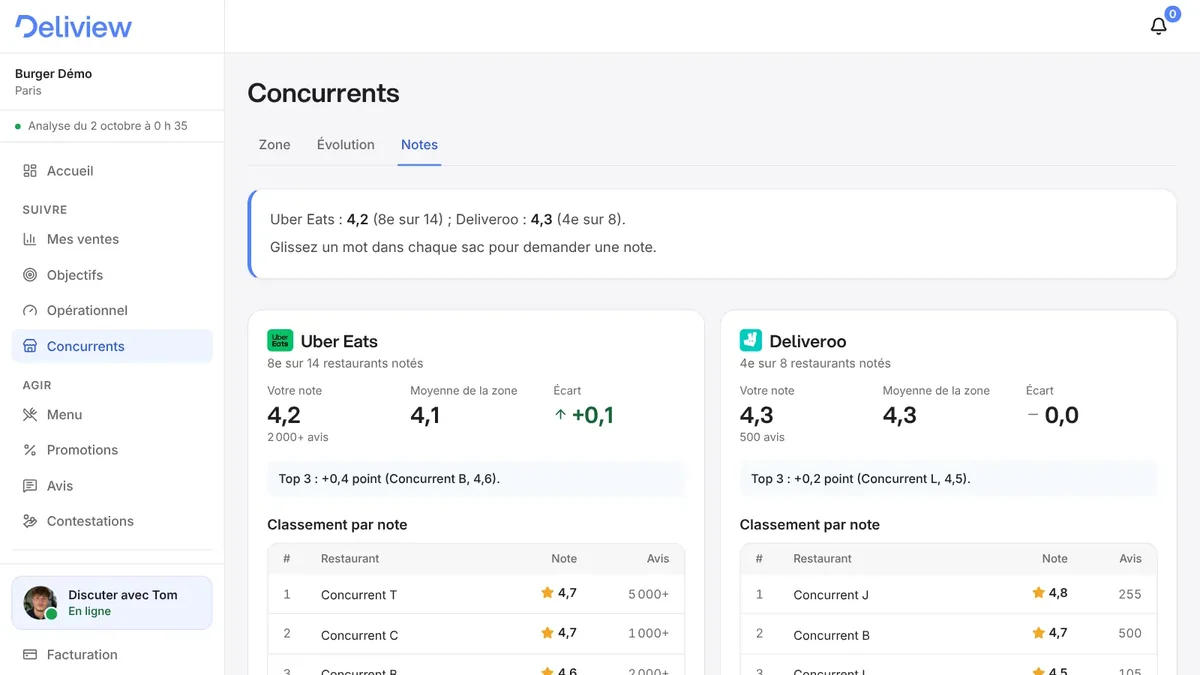
Deliveroo highlights the ones that have received “the best user reviews in the neighbourhood”, in a “Mieux notés” (top rated) banner. Its Partner Hub lets you “compare your ratings with those of other restaurants in your area” (translated from French). Example: 4.4 puts you at the top if your neighbours are between 4.1 and 4.3, and at the bottom if they are between 4.6 and 4.8.
Look at the number of ratings too: an average built on 15 ratings moves much faster than an average built on 500. And keep an eye on the platforms’ own thresholds, such as Uber Eats’ Success Score or Deliveroo’s “Score Confiance”.
Deliview compares your rating and your number of reviews with those of the restaurants in your area, platform by platform: see your rating against those in your area.
Where should you start this week?
Start from last month’s bad ratings: they tell you what to fix first.
- Note down your rating on each platform, and those of five neighbours with the same cuisine.
- Read the comments on the bad ratings in Uber Eats Manager and the Partner Hub, then sort them: missing, error, delay, packaging, taste.
- Fix the most frequent cause from your next service, with a simple step you can check.
- Reply to recent reviews, starting with the harshest. On Deliveroo, you have 30 days.
- Report the reviews that break the platform’s rules.
- Take stock again in a month. On Uber Eats, your last three months count the most; on Deliveroo, your last 400 ratings.
In Deliview
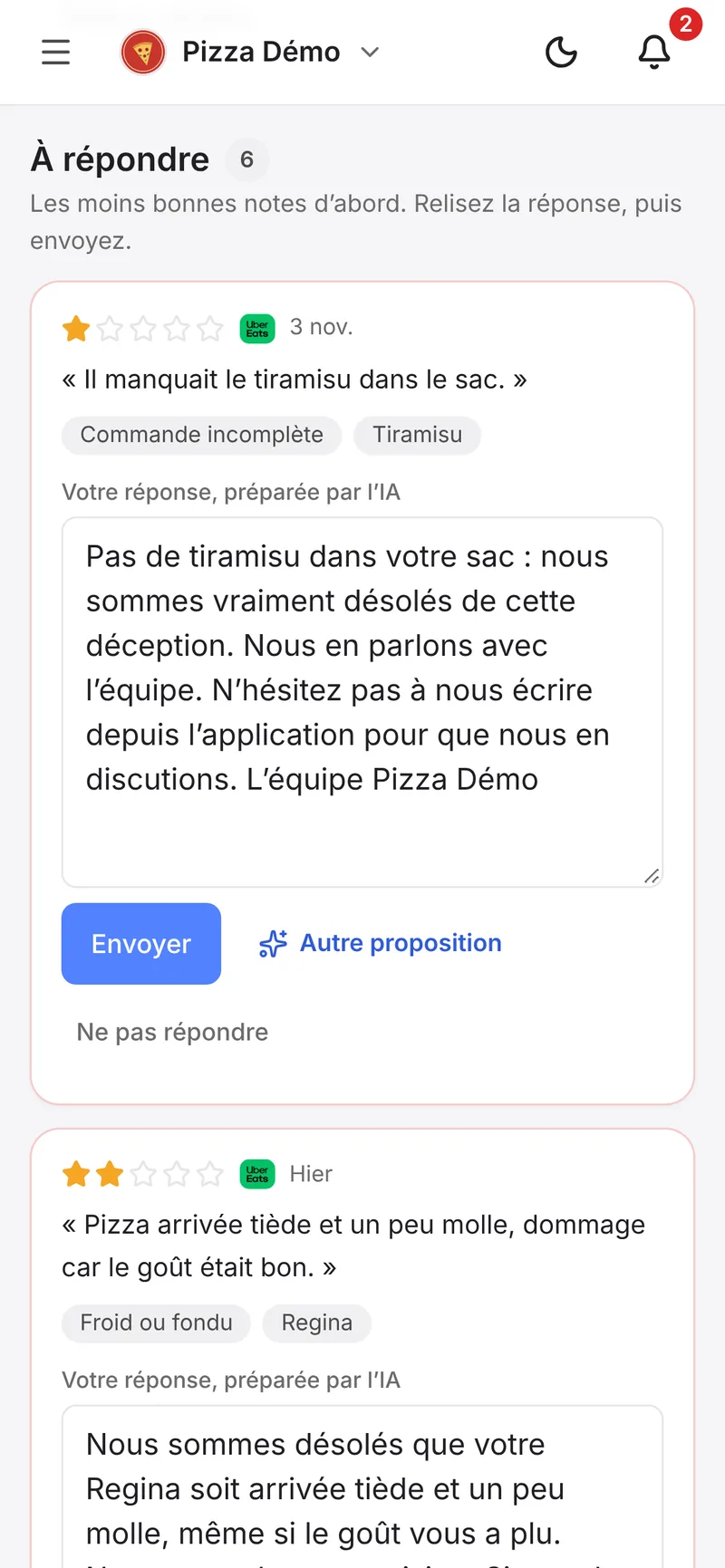
A reply ready for every review
Deliview brings your Uber Eats and Deliveroo reviews together. For each one, the AI prepares a reply in the restaurant’s name: you read it, you send it.
Sources
- Les notes et évaluations sur Uber Eats, Uber, accessed 1 October 2026.
- Notes des commerçants, Uber, accessed 1 October 2026.
- FAQ sur les notes, Uber, accessed 1 October 2026.
- Politique de Score de Réussite Partenaire - Restaurants Partenaires, Uber, accessed 1 October 2026.
- 4 façons d’augmenter la satisfaction des utilisateurs, Uber, accessed 1 October 2026.
- Comment répondre à un commentaire négatif (avec exemples), Uber, accessed 1 October 2026.
- Répondez directement aux commentaires des clients, Uber, accessed 1 October 2026.
- Notation des commandes, Deliveroo, accessed 1 October 2026.
- Avis et notes dans l’application Deliveroo, Deliveroo, accessed 1 October 2026.
- Répondez aux avis de votre clientèle, Deliveroo, accessed 1 October 2026.
- Où puis-je voir mes notes ?, Deliveroo, accessed 1 October 2026.
- Comment éviter les articles manquants ou incorrects afin de réduire les remboursements et protéger vos notes, Deliveroo, accessed 1 October 2026.
- Politiques Deliveroo (lignes directrices relatives à la communauté, Programme Confiance), Deliveroo, accessed 1 October 2026.
- Classement et référencement de nos partenaires, Deliveroo, accessed 1 October 2026.
- Avis en ligne : attention aux faux commentaires !, Ministère de l’Économie (DGCCRF), accessed 1 October 2026.
- Comment gérer votre restaurant avec Uber Eats Manager, Uber, accessed 31 October 2026.
- Article L132-2 du Code de la consommation, Légifrance, accessed 31 October 2026.
- Pratiques commerciales trompeuses : les clés pour les reconnaître et s’en prémunir, Ministère de l’Économie (DGCCRF), accessed 1 October 2026.


