
How to set your prices on Uber Eats and Deliveroo without losing money or customers

By Tom Voisin, founder of Deliview Published Updated 6 min read
No commitment.
Which costs go into the price of a delivered dish?
Four items weigh on every delivered dish: ingredients, packaging, VAT and the platform’s commission. Your displayed price must cover them and leave enough to pay the team, the rent and your profit.
Take the ingredient cost from your recipe costing sheets. Add the packaging, which dine-in doesn’t need: box, bag, cutlery, sauce pot.
VAT
The customer sees a price including VAT. At Uber Eats, the supplementary terms for partners state that the price of each product “will include VAT” (translated from French). According to the BOFiP, the official guidance of the French tax authorities, dishes prepared for immediate consumption, sold as takeaway or for delivery, fall under the 10% rate. Alcoholic drinks fall under the 20% rate.
Have your accountant confirm the rate for each product.
The commission
The commission depends on your contract and can differ between Uber Eats and Deliveroo. In their contracts, both platforms call it “frais de service” (service fees). At Uber Eats, these fees are “specifically set out on the Order Form” (translated from French), according to the supplementary terms. Take your rate, its calculation basis and any VAT on these fees from your contract or your statements.
See our articles on the Uber Eats commission and the Deliveroo commission.
How do you calculate your floor price?
The floor price is the displayed price below which a dish no longer covers your costs and the margin you are aiming for. It is calculated in four steps, for each dish and each platform.
- Add up the food cost and the packaging of the dish.
- Add what you need to keep per dish to pay the team, the rent, energy and your profit.
- Calculate the share of the displayed price you keep after VAT and commission: 1 ÷ (1 + VAT rate) − commission rate.
- Divide the total from step 2 by this share: you get your floor price including VAT.
This formula assumes a commission calculated on the price including VAT. If it is based on the price excluding VAT, step 3 becomes (1 − commission rate) ÷ (1 + VAT rate).
A worked example
Take a pizza: €2.80 of ingredients, €0.40 of packaging and €3.50 to keep per pizza. The total for step 2 is €6.70. Let’s use 10% VAT and a 30% commission on the displayed price, a rate chosen for the example.
The share you keep is 1 ÷ 1.10 − 0.30, or about 0.609. The floor price is therefore 6.70 ÷ 0.609, or €11.00. The table checks the calculation at this price, then at the rounded price of €11.50.
| For a pizza displayed at | €11.00 | €11.50 |
|---|---|---|
| VAT at 10% | €1.00 | €1.05 |
| Commission in the example (30%, excl. VAT) | €3.30 | €3.45 |
| Ingredients | €2.80 | €2.80 |
| Packaging | €0.40 | €0.40 |
| What you keep | €3.50 | €3.80 |
Then redo the calculation with the price after discount. With a 20% discount, the €11.50 pizza drops to €9.20. You then keep only €2.40, below the €3.50 you were aiming for.
When one of your promotions reduces the price of a product, Uber Eats calculates its service fees on the reduced price. Deliveroo does the same when a promotion you fund reduces the basket.
Where does your price stand against the restaurants in your area?
Compare each dish with the same dish, at the same size, at the restaurants that deliver to your customers. Use the median of their prices rather than the average: a single very expensive or very cheap restaurant barely moves it.
If your price is more than 10% away from the median, on at least two comparisons, you have a signal. The full method is in our guide to analysing your competitors’ prices.
Then set the median against your floor price. If it falls below your floor, don’t match it: rethink the recipe, the portion or the packaging instead. If it is clearly above your price, you have room to go up.
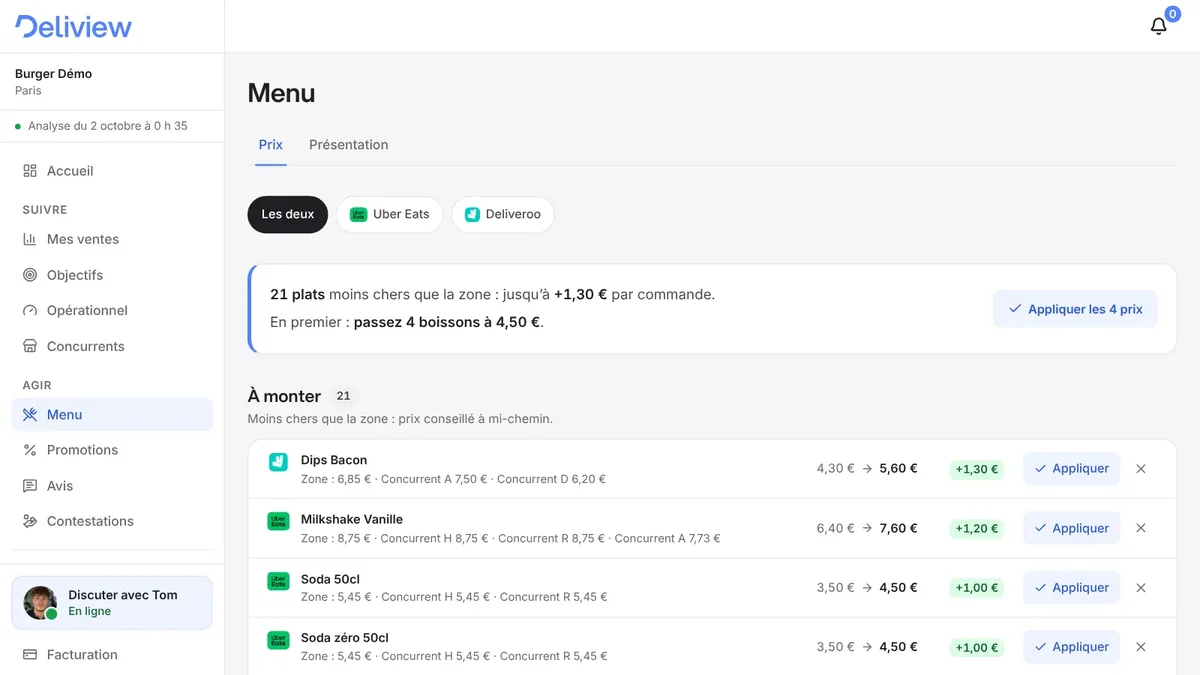
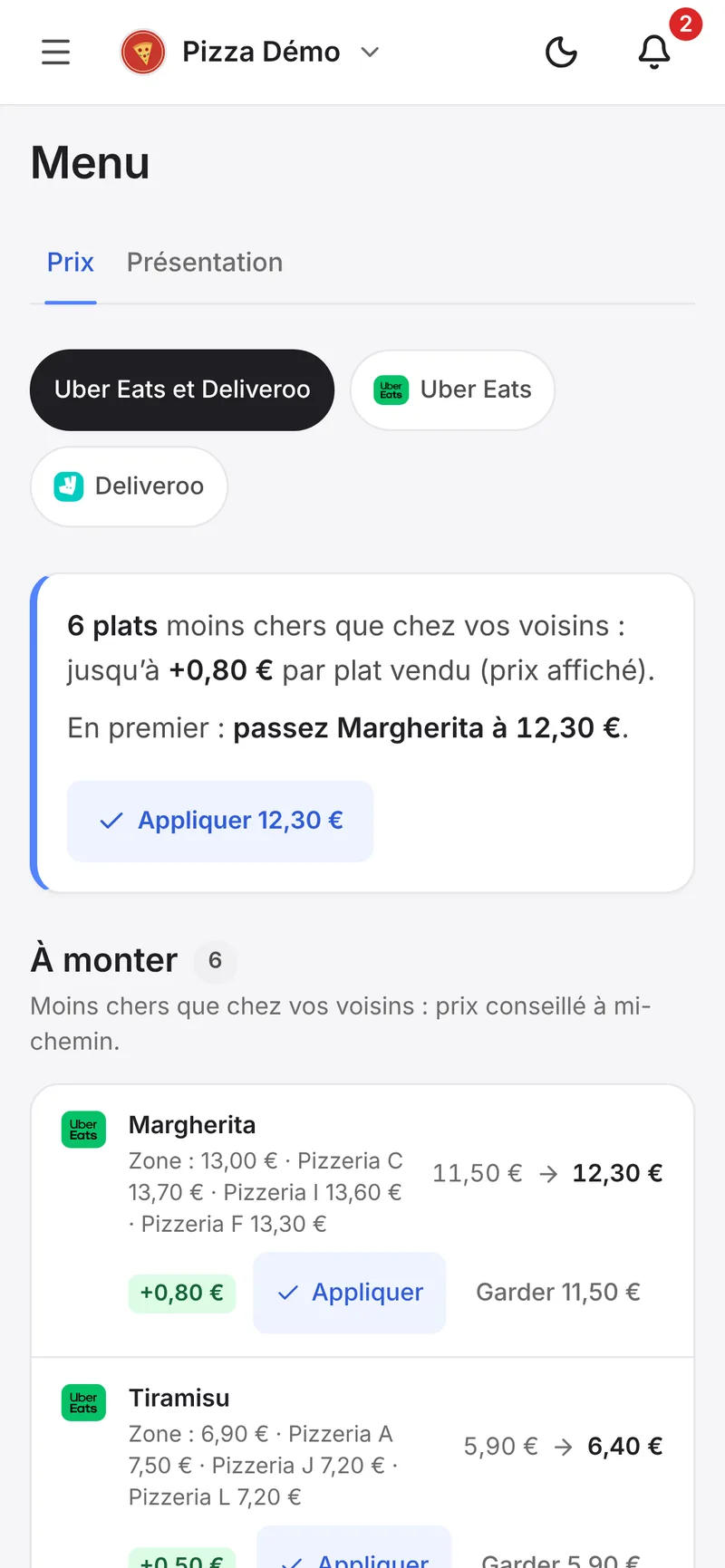
Deliview does this check for you: it picks up to 20 restaurants in your area and compares each dish with the same dish at theirs. When a dish is too expensive or underpriced, it suggests a price, names the dishes compared and shows the impact per 100 sales. See your prices against those in your neighbourhood, with the suggested price for each dish.
Are you allowed to charge more for delivery than in your dining room?
Yes, in principle: prices are freely set in France, and you can show a different price in your dining room, on Uber Eats and on Deliveroo. Two conditions: the customer sees the price including VAT before ordering, and you respect your platform contract.
The principle comes from article L410-2 of the French Commercial Code. Except where the law provides otherwise, prices “are freely determined by competition” (translated from French). The DGCCRF, the French consumer protection authority, says so for your trade in its factsheet on restaurants: “The prices charged by restaurant owners are free” (translated from French).
This freedom comes with a duty to inform, which the DGCCRF links in particular to article L112-1 of the French Consumer Code. According to its factsheet on price information, prices must be “expressed in euros and including all taxes” (translated from French). The customer must be able to know them before the sale is concluded, including at a distance and online.
Your platform contract adds its own rules. At Uber Eats, the supplementary terms are clear: “It is the Partner’s responsibility to determine and set the Retail Price” (translated from French). This text, amended on 10 September 2026, also asks you, unless otherwise agreed, to provide the prices charged in your own restaurants.
Uber can use them as reference prices to “measure the price markup rate” (translated from French). This measurement is used in applying your Order Form. The platform can also take your prices into account when deciding how to feature and list you. So reread your Order Form before widening the gap with your dining room.
At Deliveroo, the menu information policy, updated in May 2026, makes you responsible for the accuracy of your menu information. It points out that the rules on displaying and setting prices apply on the platform, particularly for discounts.
This summary is not a substitute for legal advice: for a specific case, ask a lawyer or your accountant.
How do you change your prices without driving customers away?
Change a few dishes at a time, in small steps, and look at the sales before going further. That way you will know which change produced which effect.
Choose two or three dishes, not the whole menu. Note the date, the old price and the new one, platform by platform. Then compare their sales over the four weeks before and the four weeks after.
For a big increase, go up in two stages, a few weeks apart. Also check that every price gap between your Uber Eats listing and your Deliveroo listing is intentional.
Finally, avoid raising your prices just before a promotion. Deliveroo’s terms and conditions cite “increasing your prices before an Offer” (translated from French) as an example of abusive or misleading use, which can lead to suspension. They also cap the reference price of an offer at the lowest price of the 30 days before its launch.
Where should you start this week?
Start with your best sellers: they weigh the most on your margin.
- List your five best-selling dishes on each platform.
- Calculate their floor price with your real commission rate.
- Note the price of the same dish, at the same size, at five restaurants that deliver to your neighbourhood.
- First fix the dishes displayed below their floor price.
- Note the date of each change and track the sales of these dishes for four weeks.
Compare my prices with my competitors
In Deliview
Every dish at the right price against your competitors
Deliview compares your dishes with the same dish at your competitors, and tells you which to raise or lower.
Sources
- Code de commerce, titre Ier : dispositions générales (articles L410-1 à L410-6), Légifrance, accessed 1 October 2026.
- Restaurants : droits et obligations des professionnels, DGCCRF, ministère de l’Économie, accessed 1 October 2026.
- L’information sur les prix, DGCCRF, ministère de l’Économie, accessed 1 October 2026.
- Conditions complémentaires Uber Eats pour les Partenaires, Uber, accessed 1 October 2026.
- Conditions générales des partenaires Deliveroo, Deliveroo, accessed 1 October 2026.
- Politiques des partenaires Deliveroo, Deliveroo, accessed 1 October 2026.
- TVA - Liquidation - Taux réduits - Produits destinés à l’alimentation humaine (BOI-TVA-LIQ-30-10-10), BOFiP-Impôts, Direction générale des Finances publiques, accessed 1 October 2026.


