
How to analyse your competitors’ prices on Uber Eats and Deliveroo

By Tom Voisin, founder of Deliview Published Updated 5 min read
No commitment.

Which competitors should you choose?
Pick five to ten restaurants serving the same cuisine, that deliver in your area and that your customers see in the app. They are the ones your customers compare before ordering.
Open Uber Eats and Deliveroo with a regular customer’s address, not the restaurant’s. Search for your signature dish and note the restaurants that come up: you see roughly what your customers see.
Stick to the same cuisine: a pizzeria is compared with pizzerias, a burger with burgers. Add one or two restaurants your customers mention, even if they are a little further away.
Do the price check on each platform separately: don’t assume a restaurant shows the same prices on Uber Eats and on Deliveroo.
How do you compare like with like?
Compare the same dish, at the same size or volume. A 33 cm pizza is compared with 33 cm pizzas, a 33 cl can with 33 cl cans.
A meal deal is compared with meal deals of the same make-up: a burger with fries and a drink is not compared with a burger on its own. A recipe with no equivalent at the restaurants around you is best compared within its family, pizzas or desserts, with no exact price to copy.
Write everything down in a table
One row per restaurant and per dish is enough, with the date of the price check. Here is a fictional price check on Uber Eats, for a 33 cm Margherita.
| Restaurant | Price shown | Promotion shown | Price paid for the pizza |
|---|---|---|---|
| Your restaurant | €14.00 | None | €14.00 |
| Restaurant A | €11.00 | None | €11.00 |
| Restaurant B | €12.00 | None | €12.00 |
| Restaurant C | €12.50 | 20% off the pizza | €10.00 |
| Restaurant D | €13.00 | None | €13.00 |
| Restaurant E | €19.00 | None | €19.00 |
Why the median rather than the average?
The median is the middle price, once prices are ranked from cheapest to most expensive. An extreme price pulls the average up or down, while the median barely moves.
Take the five competitors in the table: €11.00, €12.00, €12.50, €13.00 and €19.00. Their average is €13.50, that is €67.50 divided by 5. Their median is €12.50, the third price out of five.
Your Margherita at €14.00 is 3.7% above the average, which looks reasonable. Yet it is 12% above the median. Replace restaurant E’s €19.00 with €14.00: the median stays at €12.50 and the average also drops to €12.50. A single price was enough to hide the gap.
With an even number of prices, the median is the average of the two middle prices. Calculate it on the prices shown and read the promotions separately.
How do you take promotions into account?
Note two prices for each dish: the price shown and the price paid with the promotion. Calculate the median on the prices shown, then look at who runs promotions, on which dishes and how often.
A discount on a dish changes the price paid. With 20% off, restaurant C’s Margherita goes from €12.50 to €10.00. An offer tied to a minimum order value doesn’t change the price of the dish on its own: note it in a separate column.
Offers come in several forms. According to Uber Eats’ promotions page, they range “from discounts offered above a minimum order value to free dishes” (translated from French). Deliveroo’s terms and conditions in France state that a basket discount applies to the subtotal of the items, excluding delivery and service fees.
A struck-through price shows a reference price. On Deliveroo in France, this price cannot be higher than the lowest price charged in the 30 days before the offer starts. A competitor showing the same discount at every price check is, in practice, selling at its discounted price: compare yourself with that price too. To judge your own offers, read our article on profitable promotions on Uber Eats and Deliveroo.
How do you read the result?
Calculate the gap between your price and the median. Beyond 10% above or below, with at least two comparable restaurants, you have a signal. In between, your price is well placed.
The gap is calculated like this: (your price − median) ÷ median. In the example, (14.00 − 12.50) ÷ 12.50 gives 12%, above the 10% threshold.
- More than 10% above: look for what justifies the gap, such as size, ingredients or your rating. With no visible reason, move closer to the median, without going below your floor price.
- More than 10% below: you are probably leaving margin behind. Raise prices in steps and follow your sales after each increase.
- A single comparison: don’t draw a conclusion. Widen the area or wait for the next price check.
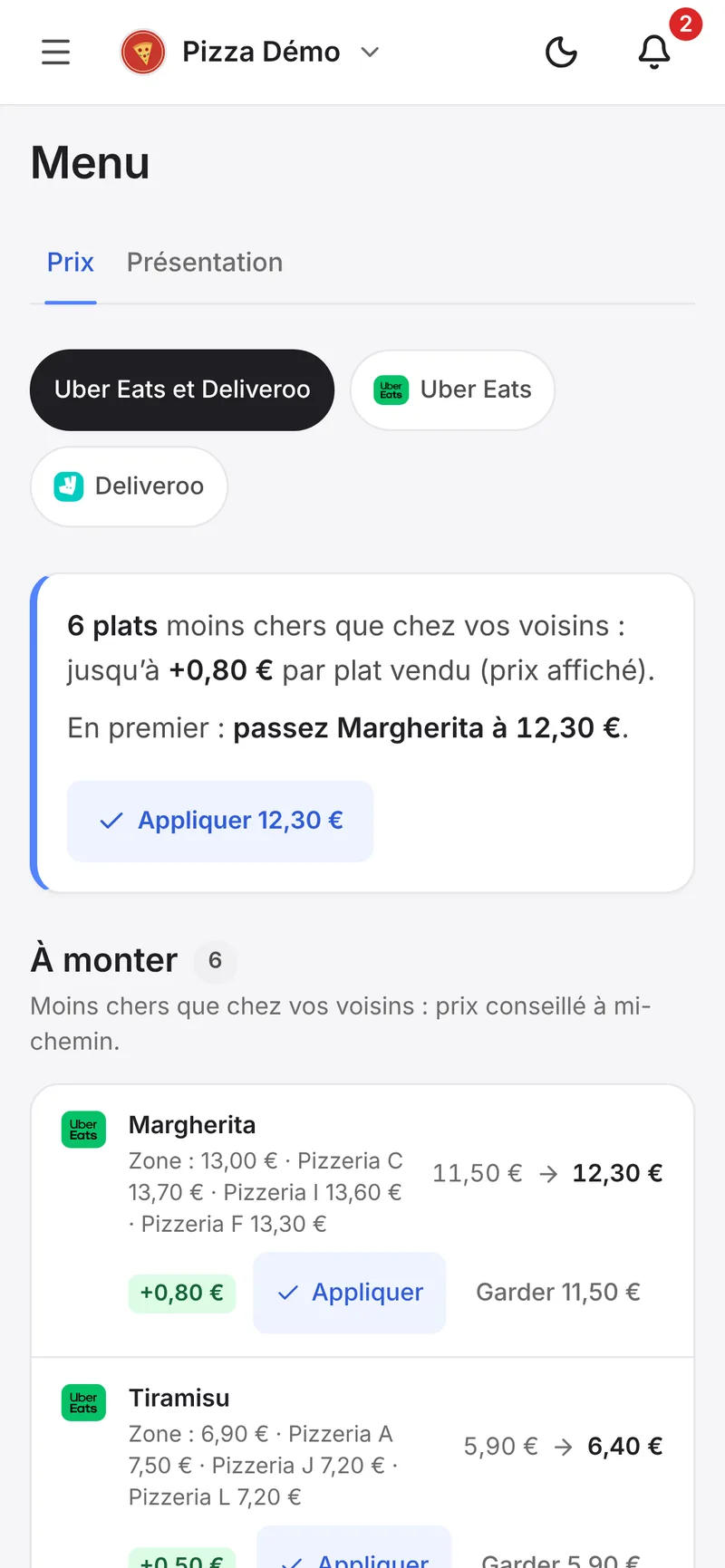
Deliview compares your prices with those in your neighbourhood on Uber Eats and Deliveroo. It picks up to 20 restaurants in your area, including up to 3 of your choice, and compares each dish with the same dish at the same size. It calculates the median and the gap, and only draws a conclusion with at least 2 competitors. It also flags the promotions shown and what has changed since the previous analysis.
How often should you repeat the exercise?
Once a month is enough in normal times. Also repeat it after you change your menu, or when a new restaurant arrives in your area.
Restaurant prices move: in France, according to Insee, the national statistics institute, they rose by 2.1% year on year in August 2026. At the restaurants around you, a new menu or a promotion can shift the median from one month to the next.
Keep your old tables. Over three months, how a competitor changes tells you more than a one-off price check: regular increases, a permanent promotion, a new size.
Where do you start this week?
Start small: three dishes, five competitors, one platform.
- Choose three dishes: your best seller, a meal deal and a drink.
- Open Uber Eats with a regular customer’s address and note five competitors serving your cuisine.
- For each one, record the price shown, the size, the promotion and the date.
- Calculate the median and your gap for each dish.
- For each gap of more than 10%, decide on an action and write it down.
Then do the same price check on Deliveroo, and start again the following month.
In Deliview
Every dish at the right price against your competitors
Deliview compares your dishes with the same dish at your competitors, and tells you which to raise or lower.
Sources
- En août 2026, les prix à la consommation augmentent de 2,4 % sur un an (Informations rapides n° 218), Insee, accessed 1 October 2026.
- Mettez en place des promotions pour votre établissement, Uber, accessed 1 October 2026.
- Conditions générales des partenaires Deliveroo, Deliveroo, accessed 1 October 2026.


