
Uber Eats commission for a restaurant: what Uber Eats takes and what you keep

By Tom Voisin, founder of Deliview Published Updated 6 min read
No commitment.
How much does Uber Eats take on an order?
Uber Eats charges “service fees” (translated from French): a percentage of your dishes’ price including VAT. Its pricing page for France, checked on 26 October 2026, shows a rate for each ordering method.
| Method shown | Fees | Orders from Uber One members |
|---|---|---|
| Delivery by an Uber courier (“Uber Delivery”) | 30% | 33% |
| “Livraison personnalisée” (custom delivery) | 15% | 18% |
| Collection by the customer (“Prise en charge”, pickup) | 15% | 18% |
On top of this comes a weekly subscription that depends on the device: €1.99 with your own, €3.99 with a tablet, €5.49 with a tablet and printer.
Yet a note at the bottom of that same page states that these plans are “only available in Japan” (translated from French). So take these rates as a rough benchmark only. Your rate is the one in your contract, which spells it out: your service fees “are specifically set out in the Order Form” (translated from French).
Does the rate change if you deliver yourself?
It can. The Uber Eats contract sets fees for each of the three methods below, with a percentage written on your order form:
- delivery by a courier from the Uber network, or “Méthode de la Marketplace” (marketplace method)
- delivery by your own riders, or “Méthode de l’Agrégateur” (aggregator method)
- collection from the restaurant by the customer, or “Méthode sans livraison” (no-delivery method)
The pricing page shows 15% for “livraison personnalisée”, without saying who delivers, and with the same note about Japan. Ask Uber Eats for your rate before choosing this method.
How do you calculate what you keep on an order?
Start from the price including VAT paid by the customer, take off the fees and their VAT, then do the maths excluding VAT. The contract sets the basis: the sale price “including VAT”, “multiplied by the percentage” of your fees (translated from French).
These fees are “excluding VAT”. If VAT applies to them, you pay it “on top” (both translated from French). The example counts it at the standard French rate of 20%, which applies to transactions with no other rate set, according to the BOFiP, the French tax authority’s official guidance.
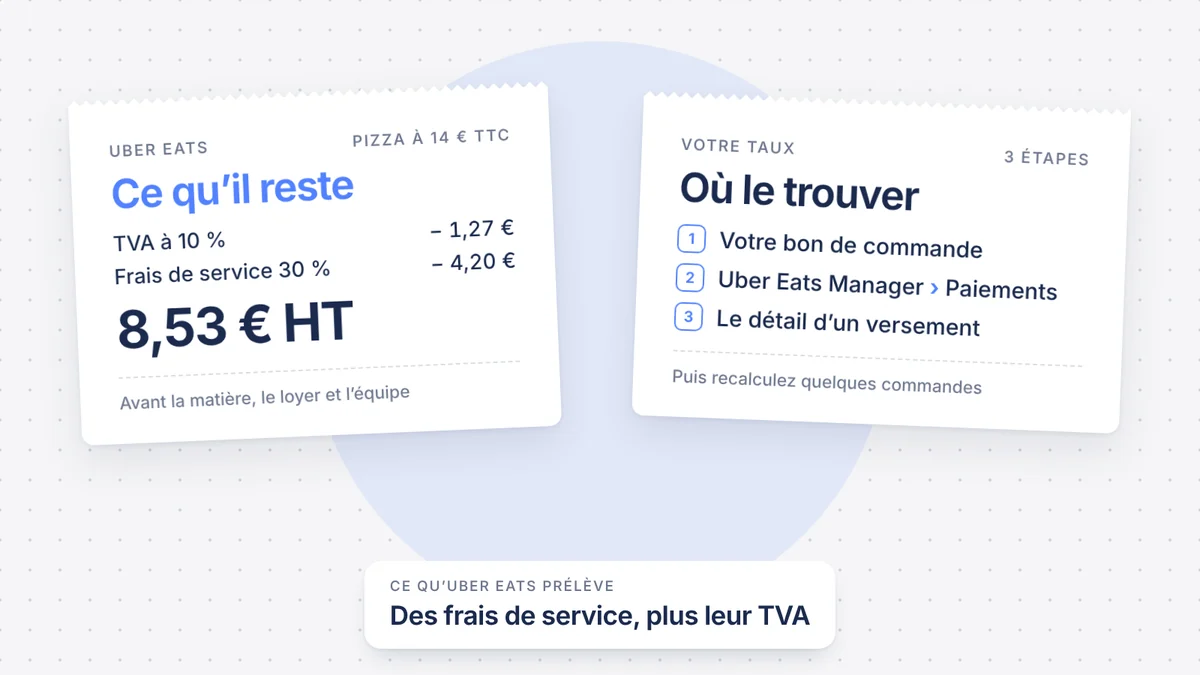
Take a pizza sold at €14, delivered by an Uber courier, with a 30% rate.
| What Uber Eats pays you | Amount |
|---|---|
| Price paid by the customer (incl. VAT) | €14.00 |
| Service fees: €14.00 × 30% | −€4.20 |
| 20% VAT on these fees | −€0.84 |
| Payout for this pizza | €8.96 |
This payout doesn’t yet tell you what you keep. In France, a pizza delivered to be eaten straight away is in principle subject to 10% VAT. The BOFiP does indeed cover “delivered products intended for immediate consumption” (translated from French).
| What you keep (excl. VAT) | Amount |
|---|---|
| Price excluding VAT (€14 ÷ 1.10) | €12.73 |
| Service fees excluding VAT | −€4.20 |
| Left before food cost | €8.53 |
| Ingredients and packaging (example) | −€4.00 |
| Left for the team, the rent and the profit | €4.53 |
The VAT paid on the fees (€0.84) drops out of this calculation if you reclaim it on your VAT return. Have your accountant confirm this point, and your VAT rate. The breakdown of rates is in our guide on VAT on delivery sales.
Finally, add the subscription: from €1.99 to €5.49 a week on the pricing page. With 50 orders a week, that comes to €0.04 to €0.11 per order.
What comes on top of the service fees?
Promotions, ads and refunds. The contract provides for Uber Eats to deduct them from your payouts.
- Promotions: you pay for them, and Uber can also charge “Frais d’Utilisation des Offres” (offer usage fees) on each order concerned. Their amount is given to you before the offer is created.
- Sponsored ads: they are charged per click, excluding VAT, at the price set by Uber for each placement. Your campaign stops when the weekly budget is reached, then starts again the following week.
- Refunds granted to customers on your behalf: they are taken off your takings.
The contract also provides for account “Frais d’activation” (activation fees): ask how much they are before you sign. Our guide to selling on Uber Eats and Deliveroo details what they cover.
Take a 20% discount on the pizza: the customer pays €11.20. The fees are then calculated “on the basis of the reduced Retail Price” (translated from French), i.e. €3.36 excl. VAT. You keep €6.82 excl. VAT instead of €8.53. So the €2.80 discount costs you €1.71 excl. VAT of margin, not counting offer usage fees.
Do this calculation before every promotion: our article on profitable promotions on Uber Eats and Deliveroo explains the method in detail.
How do you find your own rate?
Read your order form, then check your payment statements. Uber Eats pays you every week by bank transfer, and each payout is broken down order by order.
- Find your order form: together with the additional terms, it forms your Uber Eats contract.
- Log in to Uber Eats Manager from a computer, then open the “Paiements” (payments) tab.
- Download the breakdown of a payout: it gives “the tax, the subtotal, the fees, the adjustments and the net amount paid” (translated from French).
- Recalculate the fees on a few orders with the rate on your order form. At 30%, a €14 pizza gives €4.20 in fees, or €5.04 including VAT.
- Repeat this check on takeaway orders and on those delivered by your team.
- If the amounts don’t match, open the support chat in Uber Eats Manager.
Where do you start this week?
Start with your ten best-selling dishes on Uber Eats. For each one, calculate what is left excluding VAT after service fees, then after ingredients and packaging.
- Spot the dishes that fall below your margin target
- Choose an action for each one: price, portion, recipe or how it is showcased
- Compare with the same dish at the restaurants around you before raising a price
The contract leaves you in control: “it is for the Partner to determine and set the Retail Price” (translated from French). It also lists price among the criteria for ranking restaurants in the app. Our guide to setting your prices on Uber Eats and Deliveroo helps you find the right level.
Then do the same exercise on Deliveroo, which doesn’t publish its rates. Our article on Deliveroo commission explains where to find yours.
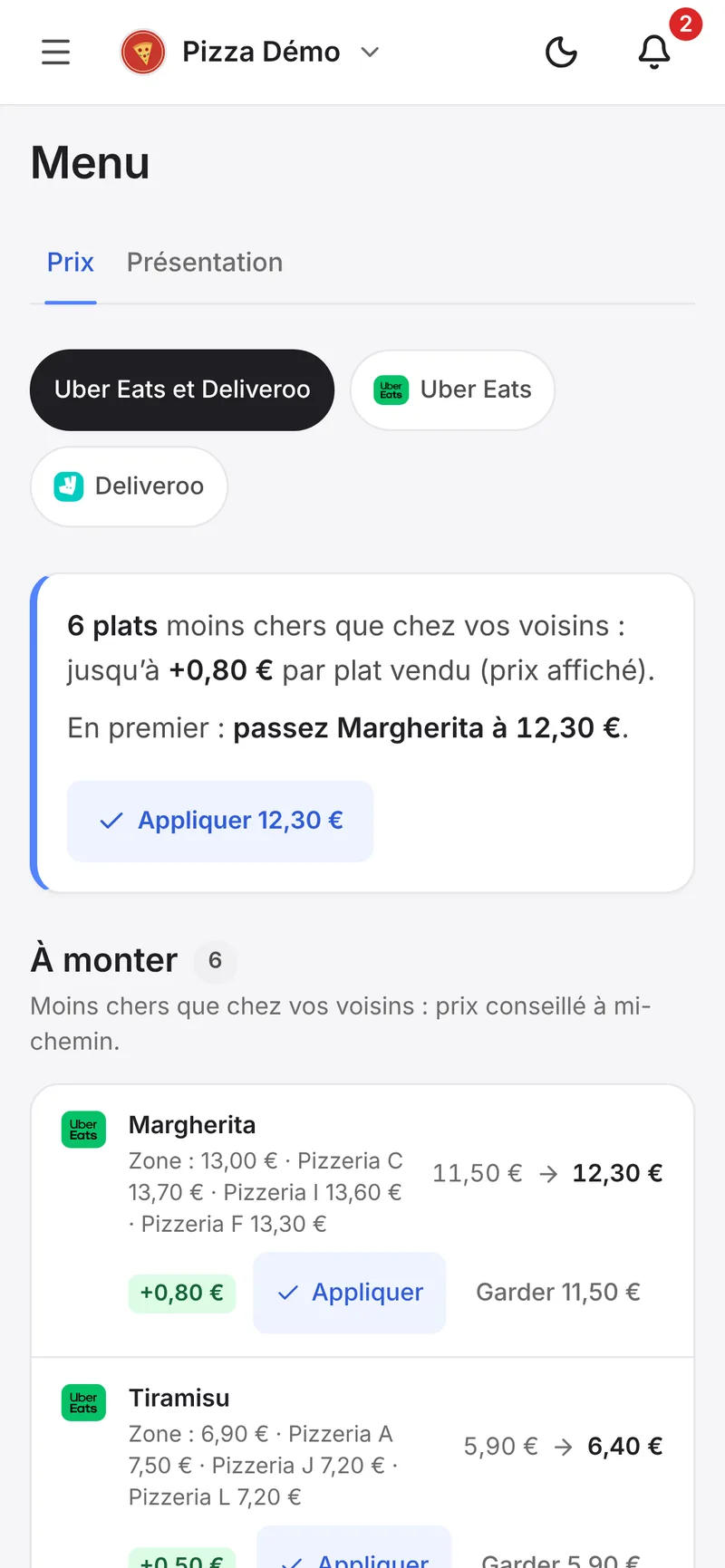
Deliview already compares each dish with the same dish, at the same size, at up to 20 neighbouring restaurants. It flags dishes that are too expensive or underpriced, and those sold at different prices on Uber Eats and Deliveroo: see what Deliview does for your prices against your competitors.
In Deliview
Every dish at the right price against your competitors
Deliview compares your dishes with the same dish at your competitors, and tells you which to raise or lower.
Sources
- Une tarification adaptée à votre entreprise, Uber, accessed 26 October 2026.
- Conditions complémentaires Uber Eats pour les Partenaires (France), Uber, accessed 1 October 2026.
- Questions fréquentes, Uber, accessed 1 October 2026.
- Solutions de livraison pour les restaurants, Uber, accessed 1 October 2026.
- Faites-vous connaître avec les annonces intégrées à l’application Uber, Uber, accessed 1 October 2026.
- TVA - Liquidation - Taux - Le taux normal (BOI-TVA-LIQ-20), Direction générale des Finances publiques (BOFiP), accessed 1 October 2026.
- Annexe TVA : taux applicables aux ventes à emporter ou à livrer de produits alimentaires préparés en vue d’une consommation immédiate (BOI-ANNX-000495), Direction générale des Finances publiques (BOFiP), accessed 1 October 2026.


