
French VAT on delivery and takeaway sales: which rate applies to your dishes and drinks?

By Tom Voisin, founder of Deliview Published Updated 6 min read
No commitment.
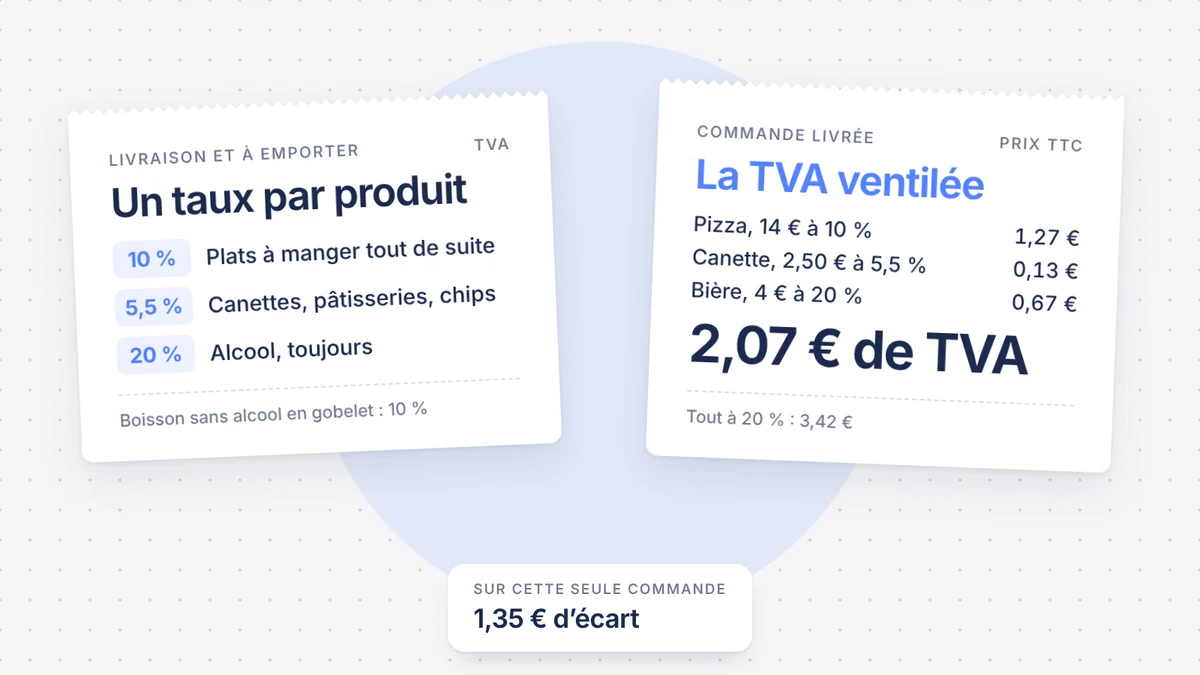
A single Uber Eats or Deliveroo order can carry three VAT rates. Here are the ones that apply, according to the official texts consulted on 1 October 2026, and how to split them. These rates apply to mainland France: Corsica and the French overseas departments have their own rules.
Which VAT rate applies to delivered or takeaway dishes?
The 10% rate applies to food prepared for immediate consumption, delivered or taken away. Products that are not meant to be eaten immediately generally fall under 5.5%, while alcohol always stays at 20%.
Article 279 of the French General Tax Code taxes at 10% “food products prepared for immediate consumption” (translated from French), sold as takeaway or delivered. The BOFiP, the official guidance of the French tax authorities, specifies that this means food and drinks “intended to be consumed in the moments following purchase” (translated from French), hot or cold. Whether your customer eats straight away or later makes no difference to the rate.
For delivery, the BOFiP summary table applies 10% “as long as preparation, sale and delivery follow on immediately from one another” (translated from French). Otherwise, it is 5.5%, the usual rate for food products.
| Product sold for delivery or takeaway | Rate |
|---|---|
| Pizzas, burgers, kebabs, fries, quiches, fresh sushi | 10% |
| Sandwiches, salads sold with cutlery | 10% |
| Single ice creams: cone, stick, individual tub under 200 ml | 10% |
| Sweet pastries, viennoiseries (croissants and similar pastries), bagged crisps, yoghurts, fruit | 5.5% |
| Frozen products, tinned food, vacuum-packed products | 5.5% |
| Soft drinks in a disposable cup, a plastic glass or a cardboard cup | 10% |
| Soft drinks in a bottle, can, carton or keg | 5.5% |
| Alcoholic drinks | 20% |
| Confectionery, some chocolates | 20% |
Source: BOFiP, BOI-ANNX-000495 and BOI-TVA-LIQ-30-10-10, versions in force on 1 October 2026.
Watch out for ready meals sold as takeaway. The BOFiP puts them at 5.5%, like frozen products, “except when they can be eaten on the premises” (translated from French). Entreprendre Service Public, the French government’s information site for businesses, however gives 10% for ready meals delivered for immediate consumption. If you sell without a dining room or offer dishes to reheat, have your accountant settle the question.
And drinks?
It all depends on alcohol and the container. Without alcohol, count 5.5% in a bottle, can or carton, and 10% in a cup. With alcohol, it is 20% in all cases.
The container matters, because a sealed drink can be kept whereas a cup is drunk straight away. Entreprendre Service Public gives the example of a small bottle of water sold as takeaway: 5.5%, even if the customer opens it as soon as they buy it.
The 20% rate covers drinks over 1.2% ABV and beers over 0.5% ABV. It applies on the premises, for takeaway and for delivery alike. An alcohol-free beer in a can, below this threshold, therefore falls under 5.5%.
What do you do when an order mixes several rates?
You have two options, both accepted by the French tax authorities, according to Entreprendre Service Public. Either you apply each product’s own rate, or you apply the highest rate to the whole sale. The first, called splitting (“ventilation”), never makes you pay more VAT than the second.
Worked example of a delivered order
Take a delivered order: a €14 pizza, a €2.50 can of soda and a €4 bottle of beer, prices including VAT. For each line, divide the price including VAT by 1.10 (10% rate), 1.055 (5.5%) or 1.20 (20%) to get the price excluding VAT.
| Product | Price incl. VAT | Rate | Price excl. VAT | VAT |
|---|---|---|---|---|
| Pizza | €14.00 | 10% | €12.73 | €1.27 |
| Can of soda | €2.50 | 5.5% | €2.37 | €0.13 |
| Bottle of beer | €4.00 | 20% | €3.33 | €0.67 |
| Total | €20.50 | €18.43 | €2.07 |
Without splitting, the whole order would be taxed at 20%: €17.08 excl. VAT and €3.42 of VAT. The difference reaches €1.35 on this single order, or €135 over 100 identical orders.
And fixed-price meal deals?
A burger, fries and can meal deal sold at a fixed price raises another question: what share of the price goes to each rate. Without splitting, the whole meal deal falls under the highest rate, here 10%.
To split, the BOFiP requires an “economically rational” method (translated from French) that you can justify. It gives the example of a split in proportion to the prices of the items sold separately, excluding VAT. This text concerns meal deals served on the premises with alcohol: for your delivered meal deals, have your accountant approve the method.
On Deliveroo, each product and each option carries its own VAT rate in Menu Manager. Check the rate of the drink offered as an option in your meal deals.
Does the platforms’ commission change your VAT?
The VAT you collect is calculated on the price of your dishes, not on the transfer you receive after commission. The VAT the platform charges you on its commission can, in principle, be deducted from the VAT you owe.
The BOFiP includes in the VAT base “all sums, values, goods or services received or to be received” (translated from French), including from a third party. The commission pays for a service the platform provides to you: it doesn’t reduce the selling price of your dishes. Promotions and refunds, on the other hand, can change that price: have your accountant confirm how they are treated.
Deliveroo details the VAT on its commission in the Hub’s “Commandes” (orders) report: subtotal, commission and “TVA sur la commission Deliveroo” (VAT on the Deliveroo commission), order by order. On Uber Eats, your invoices and tax documents can be downloaded in Uber Eats Manager, under “Paiements” (payments). For details of the fees, read our articles on the Uber Eats commission and the Deliveroo commission.
The French Ministry of the Economy points it out: “you can deduct the VAT you pay on your business purchases” (translated from French). The amount must appear on a supporting document, such as an invoice. You then pay over the difference between the VAT collected and the deductible VAT.
What you can do this week
Start by checking the rate of each product on your menu, then gather the supporting documents for your accountant.
- List your products and note the rate of each one using the table above, starting with drinks and desserts.
- On Deliveroo, check the VAT rate of each product and each option in Menu Manager.
- Download the “Commandes” report from Deliveroo’s Partner Hub: it covers 90 days at most and can be downloaded for 90 days.
- Get your invoices and tax documents from Uber Eats Manager.
- Send these documents to your accountant every month.
- Ask them about your special cases: fixed-price meal deals, ready meals, homemade desserts, promotions, refunds, the French small-business VAT exemption (“franchise en base de TVA”).
VAT rates can change with each French Finance Act (“loi de finances”). This article helps you ask the right questions, but it is no substitute for your accountant’s advice.
In Deliview
Your Uber Eats and Deliveroo data on one screen
Your sales, your prices against those in your area, your reviews and the refunds to dispute.
Sources
- ANNEXE - TVA - Tableau récapitulatif des taux applicables pour les ventes à emporter ou à livrer de produits alimentaires préparés en vue d’une consommation immédiate, en fonction des produits et des situations, Direction générale des Finances publiques (BOFiP), accessed 1 October 2026.
- TVA - Liquidation - Taux réduits - Produits destinés à l’alimentation humaine, Direction générale des Finances publiques (BOFiP), accessed 1 October 2026.
- TVA - Liquidation - Prestations de services imposables aux taux réduits - Ventes à consommer sur place, restauration collective, Direction générale des Finances publiques (BOFiP), accessed 1 October 2026.
- TVA - Liquidation - Taux - Généralités, Direction générale des Finances publiques (BOFiP), accessed 1 October 2026.
- TVA - Base d’imposition - Règles applicables à l’ensemble des opérations imposables, Direction générale des Finances publiques (BOFiP), accessed 1 October 2026.
- Taux de TVA sur les produits alimentaires et les boissons, Entreprendre Service Public (DILA), accessed 1 October 2026.
- Entreprises : ce que vous devez savoir sur la TVA, Ministère de l’Économie, accessed 1 October 2026.
- Comment consulter et exploiter les rapports dans Hub (ne concerne pas les partenaires Deliveroo Signature), Deliveroo, accessed 1 October 2026.
- Gérer votre menu Deliveroo sur le Portail Partenaire, Deliveroo, accessed 1 October 2026.
- Guide des commerçants : Comment utiliser Uber Eats Manager, Uber, accessed 1 October 2026.


