
Opening a dark kitchen in France: rules, costs and what is left after commission

By Tom Voisin, founder of Deliview Published 9 min read
No commitment.
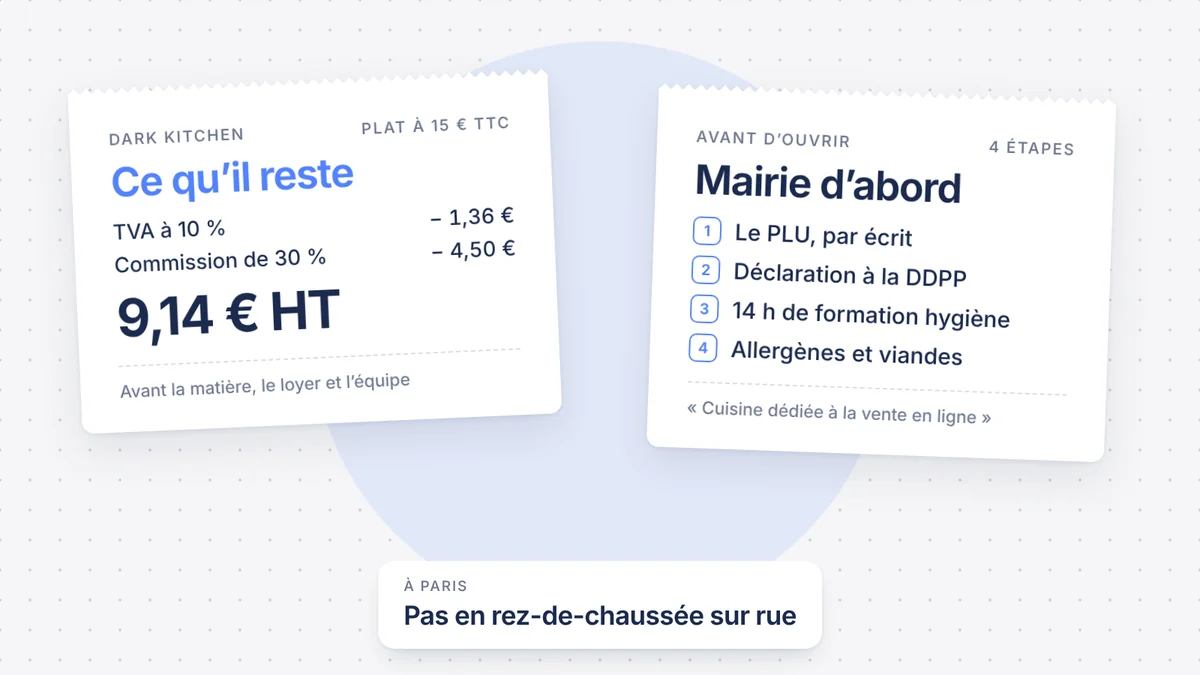
A dark kitchen is a kitchen with no dining room, which only prepares food for delivery and takeaway. Here are the rules for opening one in France, what Uber Eats and Deliveroo require, and the calculation to do before signing a lease. Texts and official pages checked on 30 and 31 October 2026.
What is a dark kitchen?
It is a restaurant with no customers on site. The official French term is “traiteur tout en ligne” (literally, all-online caterer), according to France’s official terminology committee, the “Commission d’enrichissement de la langue française” (Journal officiel, France’s official gazette, of 17 August 2024). It is a “catering business that prepares dishes intended exclusively for the delivery of orders placed online or by phone” (translated from French). It is also called a “cuisine fantôme” (ghost kitchen).
France’s consumer fraud authority (DGCCRF) talks about establishments that “operate with no space open to the public” (translated from French). Don’t confuse it with a virtual restaurant: a brand sold online from the kitchen of a restaurant that already exists. Our guide on the virtual restaurant details this lighter option.
Dark kitchen or virtual brand: where should you start?
If you already have a restaurant, first test a virtual brand in your kitchen. No new premises and no new lease, and in principle no change of use: you measure demand before committing.
A dark kitchen makes sense when your kitchen is full, or to sell in a neighbourhood where you don’t have a restaurant. A well-known operator has in fact broadened its model. According to its website, Taster, a network of delivery brands, now presents itself as a franchise network. It also opens its own shops, with takeaway.
Where can you open a dark kitchen?
Wherever the local urban development plan (PLU) allows it. The French decree of 22 March 2023 puts these kitchens in a sub-category of use of their own, “cuisine dédiée à la vente en ligne” (kitchen dedicated to online sales). It has applied since 1 July 2023, except to any PLU whose procedure had already begun. This sub-category belongs to “autres activités des secteurs primaire, secondaire ou tertiaire” (other primary, secondary or tertiary sector activities), along with industry, warehouses and offices.
The ministerial order issued the same day defines it as follows: it “covers buildings intended for preparing meals ordered electronically” (translated from French). Restaurants, by contrast, involve “receiving customers” (translated from French). Turning a restaurant or a shop into a dark kitchen therefore changes the use of the premises. At the very least, a prior declaration is needed. If the work affects the load-bearing structure or the façade, a building permit is needed, French notaries point out (report of their 2024 congress).
Each municipality can then allow, ban or regulate these kitchens in its PLU. Two examples:
- Paris: in its regulations (December 2025 version), a dark kitchen is only allowed on a plot with no housing, apart from a caretaker’s lodging. And converting a street-level ground-floor unit into a dark kitchen is prohibited.
- Valence: the city amended its PLU in early 2025 to regulate these kitchens, “which generate nuisance in many towns” (translated from French). It steers them towards areas zoned for business.
Before signing a lease, ask the planning department for the authorised use of the premises, and what the PLU allows at that address. Get the answer confirmed in writing. Also think about the neighbours, the noise from the extraction system and riders waiting outside the door.
What steps must you take before opening?
The same as for a restaurant, except for receiving the public. In 2022, the French government already put it in writing: a dark kitchen “must register its establishment with the departmental directorate for the protection of populations” (translated from French). It follows the same European hygiene rules, the “Paquet hygiène” (EU hygiene package).
- Register the establishment with the DDPP (or DDETSPP) before starting, with French official form Cerfa 13984 or online, according to the French Ministry of Agriculture.
- Train one person in hygiene: at least 14 hours. “It is enough for just one person in the establishment to have taken the training” (translated from French), states Service Public, the French government’s official information site. The training costs between €200 and €500. Three years’ experience as a manager or operator, or certain diplomas, exempt you from it.
- Show the allergens in each dish. The European INCO regulation (articles 14 and 44) requires them to be given before a remote order is completed, then on delivery.
- Show the origin of meats: the country of origin and provenance of all meats, “for delivery” as on site (translated from French). The fine goes up to €1,500 for a sole trader and €7,500 for a company, according to Service Public.
- To sell alcohol, declare a takeaway licence at the town hall or the prefecture, “at least 15 days before opening” (translated from French). It is the small licence for drinks up to 18% ABV, the large one above that. Before 22:00, the declaration is enough. Between 22:00 and 08:00, specific training is required.
These rules are enforced. In 2023, the DGCCRF inspected 646 establishments delivering meals, including 103 dark kitchens. 21% were in breach. The shortcomings often found: allergens, origin of meats, and unjustified claims such as “fait maison” (homemade), “frais” (fresh) or “local”.
Which APE code and which insurance?
For the APE code (the French business activity code), Insee, the French national statistics institute, classifies under 56.10C, “Restauration de type rapide” (fast food), restaurants “mainly offering takeaway meals” (translated from French). It is the closest code to a dark kitchen. It will become 56.11J on 1 January 2027, with Insee’s new classification (NAF 2025).
For insurance, Uber Eats has a written requirement. Its terms for merchants in France require commercial liability insurance during the contract, then for one year after. The limit is set at €1 million per claim and €2 million in total, with an insurer rated at least A- by the rating agency AM Best. Show this clause to your insurer before signing.
Do Uber Eats and Deliveroo accept a dark kitchen?
Uber Eats doesn’t publish a rule for a kitchen with no dining room. It supports restaurants that “run several brands from the same kitchen” (translated from French). But it defines a virtual restaurant as a concept that “operates from a physical storefront” (translated from French). Have your Uber Eats contact confirm your project in writing before signing a lease.
Deliveroo is more precise about brands. Each additional brand at the same address must have virtual brand status, with a “substantially different” menu (translated from French), requested from the Hub. Without this status, Deliveroo treats the newer of the two establishments as a “duplicate account” (translated from French), and suspends it. Deliveroo also asks you to show your company name and business address on your page, as the European Digital Services Act (DSA) requires. So your customers see your company’s name and address.
Deliveroo also offers its own kitchens designed for delivery, the Editions sites: it lists five in France. They are reserved for its partners, for a percentage commission. Finally, since 27 October 2026, it has banned dish photos created by AI: for a new brand, plan for real photos.
How much is left on a dish sold at €15?
€9.14 excluding tax, before ingredients, packaging, rent and team. The calculation, with the 30% commission shown on Uber Eats’ pricing page for delivery by its couriers:
| Amount | |
|---|---|
| Price paid by the customer | €15.00 incl. VAT |
| 10% French VAT (meal delivered to be eaten straight away) | €1.36 |
| Price excluding VAT | €13.64 |
| Commission of 30% of the price incl. VAT | €4.50 excl. VAT, with €0.90 of reclaimable VAT on top |
| Left for you, excluding VAT | €9.14 |
Your real rate is the one in your contract. Uber Eats states that the plans on its pricing page are “only available in Japan” (translated from French). The same page shows 33% for Uber One members, and Deliveroo publishes no rate. Redo the calculation with yours, following our guides on Uber Eats commission and VAT on delivery sales.
Then take off ingredients and packaging. Let’s say €3.50 excl. VAT per dish: €5.64 is left to pay for the premises, energy and the team. With €6,000 of fixed costs a month, you need to sell around 1,064 dishes before earning the first euro. That makes 36 dishes a day, over 30 days. These two amounts are examples: put in your own.
How much does opening a dark kitchen cost?
Nobody can give you an accurate figure without your premises. Kitchens for rent rarely publish their rents, and the budgets going around online rarely cite their sources. Ask for written quotes for each item:
- the premises: rent, deposit, and the extraction and fit-out work;
- kitchen and refrigeration equipment;
- hygiene training, between €200 and €500 according to Service Public;
- the insurance required by Uber Eats;
- the takeaway licence, if you sell alcohol;
- menu photos, taken by you or by a professional;
- platform activation fees: Uber Eats mentions them without publishing the amount, so ask for it in writing.
Where do you start?
- If you already have a restaurant, test demand with a virtual brand in your kitchen.
- Before any lease, get the town hall’s opinion on the premises in writing, and your Uber Eats contact’s.
- Calculate what is left per dish with your real costs, then the number of dishes a day that covers your costs.
- Register the establishment with the DDPP, train one person in hygiene, and display allergens and the origin of meats.
- If you sell alcohol, declare the takeaway licence at least 15 days before opening.
Already have brands online? Deliview brings together the Uber Eats and Deliveroo sales of each restaurant and each brand. It calculates what is left after commissions, promotions, VAT and food cost. See what Deliview does.
Frequently asked questions
Do you need a licence to open a dark kitchen in France?
Not for food: you must register the establishment with the DDPP and train one person in hygiene. For alcohol, you need a takeaway licence, declared at least 15 days before opening.
Can you open a dark kitchen in Paris?
Only on a plot with no housing, apart from a caretaker’s lodging, according to the Paris PLU. Converting a street-level ground-floor unit into a dark kitchen is prohibited there. Have the planning department check the address.
Can a dark kitchen sell several brands?
Yes, under conditions. Uber Eats supports running several brands from the same kitchen, but reserves virtual restaurants for its existing partners, “under certain conditions” (translated from French). On Deliveroo, each additional brand must be approved as a virtual brand, with a substantially different menu. Have your project confirmed in writing.
In Deliview
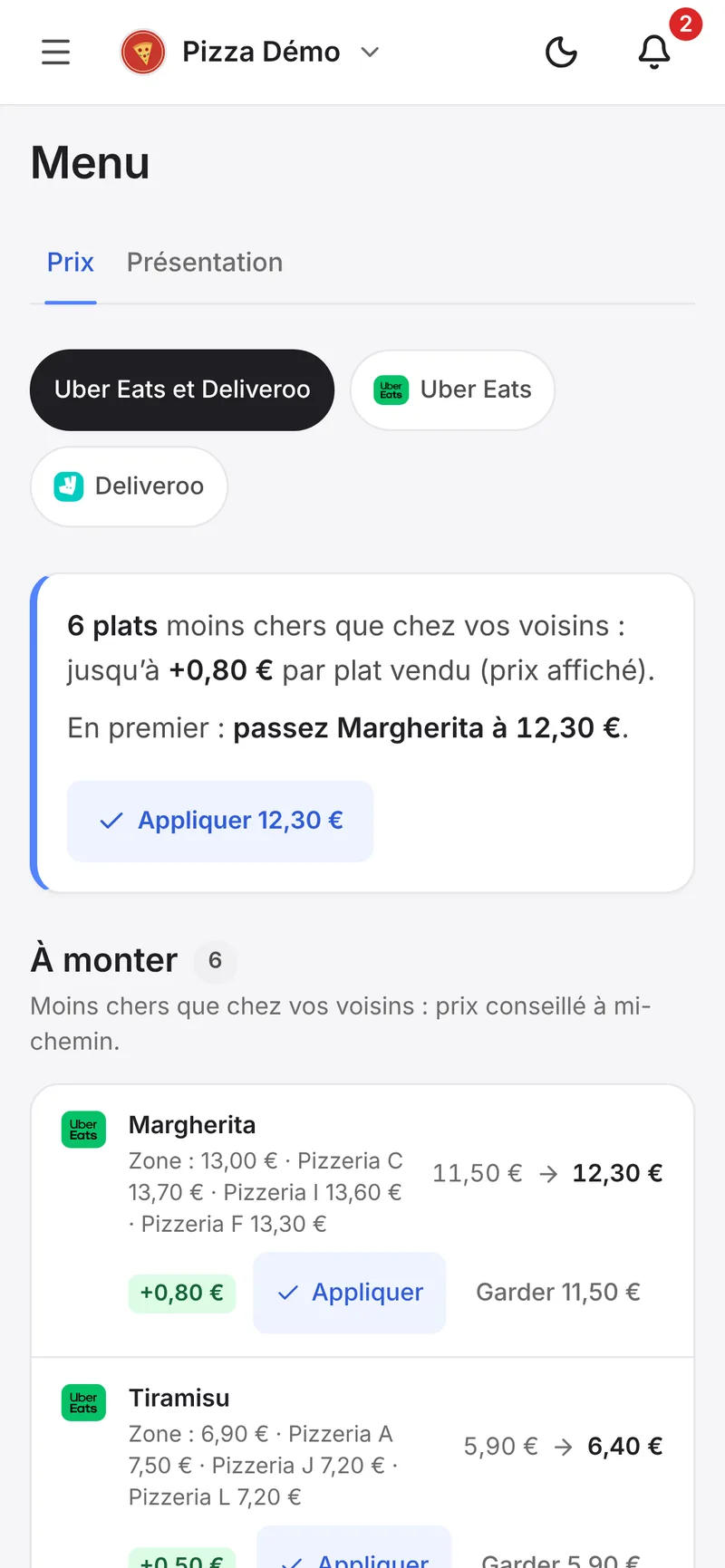
Every dish at the right price against your competitors
Deliview compares your dishes with the same dish at your competitors, and tells you which to raise or lower.
Sources
- Vocabulaire de l’économie et de la finance (traiteur tout en ligne), Commission d’enrichissement de la langue française (Bulletin officiel), accessed 30 October 2026.
- Gare aux tromperies sur les plats livrés à domicile, Ministère de l’Économie (DGCCRF), accessed 31 October 2026.
- Décret n° 2023-195 du 22 mars 2023 (destinations et sous-destinations des constructions), Légifrance, accessed 31 October 2026.
- Arrêté du 22 mars 2023 modifiant la définition des sous-destinations des constructions, Légifrance, accessed 31 October 2026.
- Les changements de destination (rapport du 120e Congrès des notaires), Congrès des notaires de France, accessed 30 October 2026.
- PLU bioclimatique, règlement, tome 1 (version de décembre 2025), Ville de Paris, accessed 30 October 2026.
- Modification n° 1 du PLU, note de présentation (janvier 2025), Ville de Valence, accessed 30 October 2026.
- Déclarer la manipulation de denrées alimentaires d’origine animale, Ministère de l’Agriculture, accessed 30 October 2026.
- Question écrite n° 149 sur les dark kitchens (réponse du 6 septembre 2022), Assemblée nationale, accessed 30 October 2026.
- Règles d’hygiène dans la restauration et les commerces alimentaires, Service Public, accessed 31 October 2026.
- Restauration : quelles obligations en matière de formation à l’hygiène des aliments ?, Ministère de l’Agriculture, accessed 30 October 2026.
- Règlement (UE) n° 1169/2011 concernant l’information des consommateurs sur les denrées alimentaires (articles 9, 14 et 44), EUR-Lex, accessed 31 October 2026.
- Réglementation dans un bar ou un restaurant (alcool, aliment, hygiène, sécurité), Service Public, accessed 30 October 2026.
- Licences de débits de boissons, Service Public, accessed 30 October 2026.
- Sous-classe 56.10C : Restauration de type rapide, Insee, accessed 30 October 2026.
- NAF 2025 : la nouvelle nomenclature d’activités, Insee, accessed 31 October 2026.
- Nomenclature NAF 2025 : tables de correspondance, Insee, accessed 30 October 2026.
- Conditions générales Uber Eats pour les commerçants (clauses 11 et 14), Uber, accessed 31 October 2026.
- Restaurants virtuels, Uber, accessed 30 October 2026.
- Tarifs, Uber, accessed 30 October 2026.
- Politiques Deliveroo pour les partenaires (marques virtuelles, information sur les menus), Deliveroo, accessed 31 October 2026.
- Questions fréquentes des partenaires (Editions), Deliveroo, accessed 31 October 2026.
- Deliveroo Editions, Deliveroo, accessed 30 October 2026.
- BOI-ANNX-000495 : taux de TVA de la vente à emporter et de la livraison, BOFiP-Impôts, accessed 30 October 2026.
- Notre réseau (devenir franchisé), Taster, accessed 31 October 2026.
- Nos Stores, Taster, accessed 31 October 2026.


