
Virtual restaurant on Uber Eats and Deliveroo: the rules for launching a second brand from your kitchen

By Tom Voisin, founder of Deliview Published Updated 6 min read
No commitment.
Virtual restaurant, virtual brand, dark kitchen: what’s the difference?
A virtual restaurant, or virtual brand, is a brand sold only for delivery, prepared in the kitchen of a restaurant that already exists. Uber Eats defines it as “a concept that only accepts and delivers digital orders placed off the premises, and that operates from a physical storefront” (translated from French).
A dark kitchen is a unit with no dining room, dedicated to online orders. Since 1 July 2023, French planning law has given it a category of its own, “cuisine dédiée à la vente en ligne” (kitchen dedicated to online sales). It covers “buildings intended for preparing meals ordered electronically” (translated from French), delivered or collected on site, points out the law firm Landot.
| Virtual brand | Dark kitchen | |
|---|---|---|
| Where do you cook? | In your restaurant’s kitchen | In dedicated premises, with no dining room |
| What you need to create | A name, a menu, photos | Equipped premises, then one or more brands |
| Planning | Nothing new, in principle | “Cuisine dédiée à la vente en ligne” category |
In between, Deliveroo rents out shared kitchens, its “Editions” sites: the platform lists 5 in France.
Can you sell on Uber Eats without a restaurant?
Without a kitchen, no. Uber Eats defines a virtual restaurant as a concept that “operates from a physical storefront” (translated from French), so from a restaurant that already exists. With no dining room, go through a dark kitchen, premises equipped for online sales. It has its own planning category (see “Do you need the town hall’s approval?”). Uber Eats doesn’t publish a rule for this case: get it confirmed before signing a lease.
What Uber Eats allows
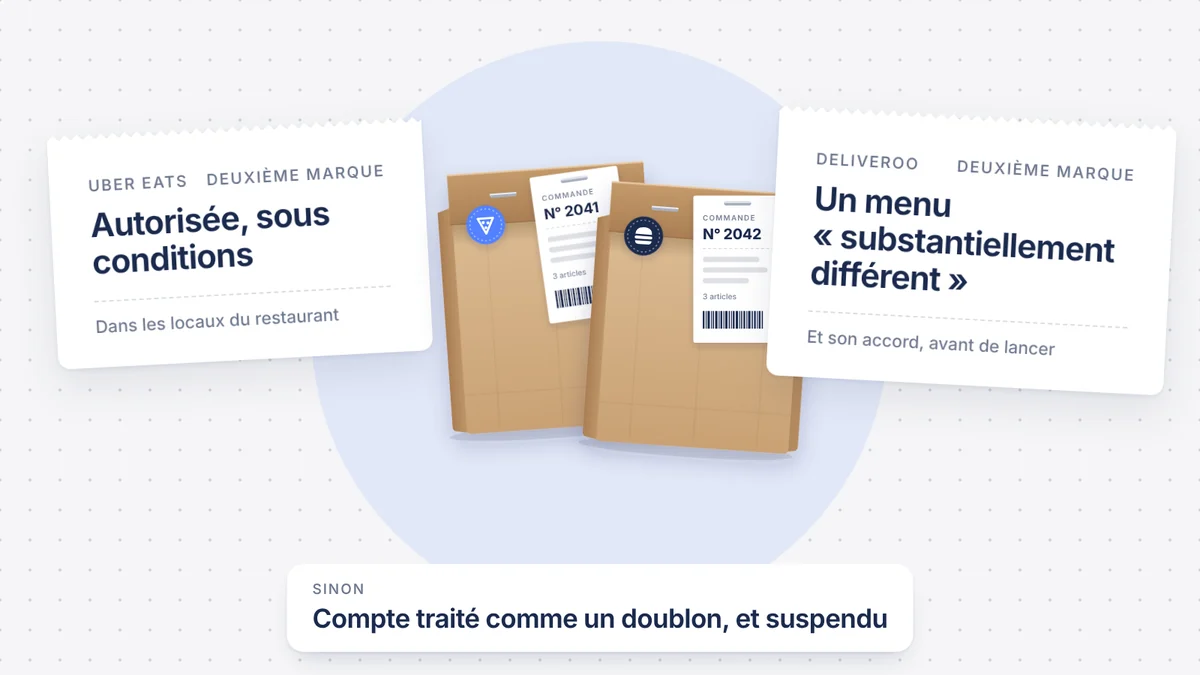
Uber Eats supports “restaurants that run several brands from the same kitchen” (translated from French). Its terms for merchants in France, amended on 10 September 2026, set four rules:
- a partner already selling on Uber Eats “may, under certain conditions, operate a Virtual Restaurant” (translated from French);
- it prepares and sells all of the brand’s meals “on the Partner’s restaurant premises” (translated from French);
- if it moves, it notifies Uber in writing at least 7 days in advance;
- Uber can remove the brand if it “reasonably believes” (translated from French) that the brand infringes intellectual property rights, the name of a well-known chain for example.
Uber Eats doesn’t publish these “certain conditions”. Ask your Uber Eats contact for them before creating the menu. Also ask whether activation fees apply to the new establishment: the sign-up page mentions a one-off activation fee, without giving the amount.
What Deliveroo allows
Deliveroo is more precise. According to its policies for partners in France, checked on 30 October 2026:
- the virtual brand’s menu must be “substantially different” (translated from French) from that of the original brand;
- you request Deliveroo’s authorisation from Restaurant Hub, before launching the brand;
- without this status, when two establishments share an address, “the most recent establishment will systematically be considered a duplicate account” (translated from French);
- “any duplicate account will be suspended” (translated from French).
Also plan the photos for the new menu. Deliveroo offers a package of 25 professional photos at €119 incl. VAT, according to its terms, in a 2024 version. You can also take them yourself by following both platforms’ photo rules.
Do you need the town hall’s approval?
For a virtual brand prepared in your restaurant, in principle no: you are not changing the use of your premises.
For a dark kitchen, check your municipality’s local urban development plan (PLU) before signing a lease. Paris is the strictest example. According to the City of Paris, its bioclimatic PLU, approved on 20 November 2024, regulates dark kitchens “strongly” (translated from French).
In the December 2025 version of its regulations, two rules apply. A dark kitchen is only allowed on a plot with no housing, apart from a caretaker’s lodging. Converting a street-level ground-floor unit into a dark kitchen is prohibited. The PLU changes over time: have the planning department confirm the rule. For all the steps, see our guide to opening a dark kitchen.
What hygiene rules for a second brand?
The same as for your restaurant. Food hygiene training remains compulsory in fast food and takeaway, and one trained person per establishment is enough, according to Service Public, the French government’s official information site.
Any establishment preparing food of animal origin must also be registered with the DDPP, the local food safety authority, before starting, with French official form Cerfa 13984, according to the French Ministry of Agriculture. Your restaurant has already done this. A dark kitchen opened in new premises must be registered in turn.
The new menu also shows its allergens and the origin of its meats, like the first one. Our article on crousty goes over these two obligations.
How much does a virtual brand cost?
No platform publishes a figure. The accountancy firm Extencia estimated in June 2026 that a virtual brand launched from an existing kitchen starts with €3,000 to €15,000. It puts a shared kitchen at €10,000 to €40,000, and an equipped dark kitchen at €40,000 to €120,000. These are orders of magnitude, with no published method.
Instead, list your own expenses:
- photos for the new menu;
- packaging in the brand’s name;
- ingredients you don’t use yet;
- any activation fees;
- launch promotions, because a new brand starts with no rating and no reviews.
How do you test a virtual brand without disrupting your kitchen?
- Choose a concept that reuses your ingredients and your equipment. A snack bar that already has a fryer can test a crousty, for example.
- Check the competition in your area, prices included, with our method to analyse your competitors’ prices.
- Write a menu that is genuinely different from the first, under a name that belongs to you.
- Ask each platform for approval before going live.
- Prepare for the rush: two brands means more orders for the same team. Set your preparation times and the “Occupé” (busy) mode, as in our guide to handling tablets in the middle of a rush.
- Take stock after four to six weeks: sales, ratings, preparation times, cancellations.
Watch your cancellations. Since 9 October 2025, Deliveroo has charged the restaurant for each order it cancels, at the amount of the service fees incl. VAT, according to its policies.
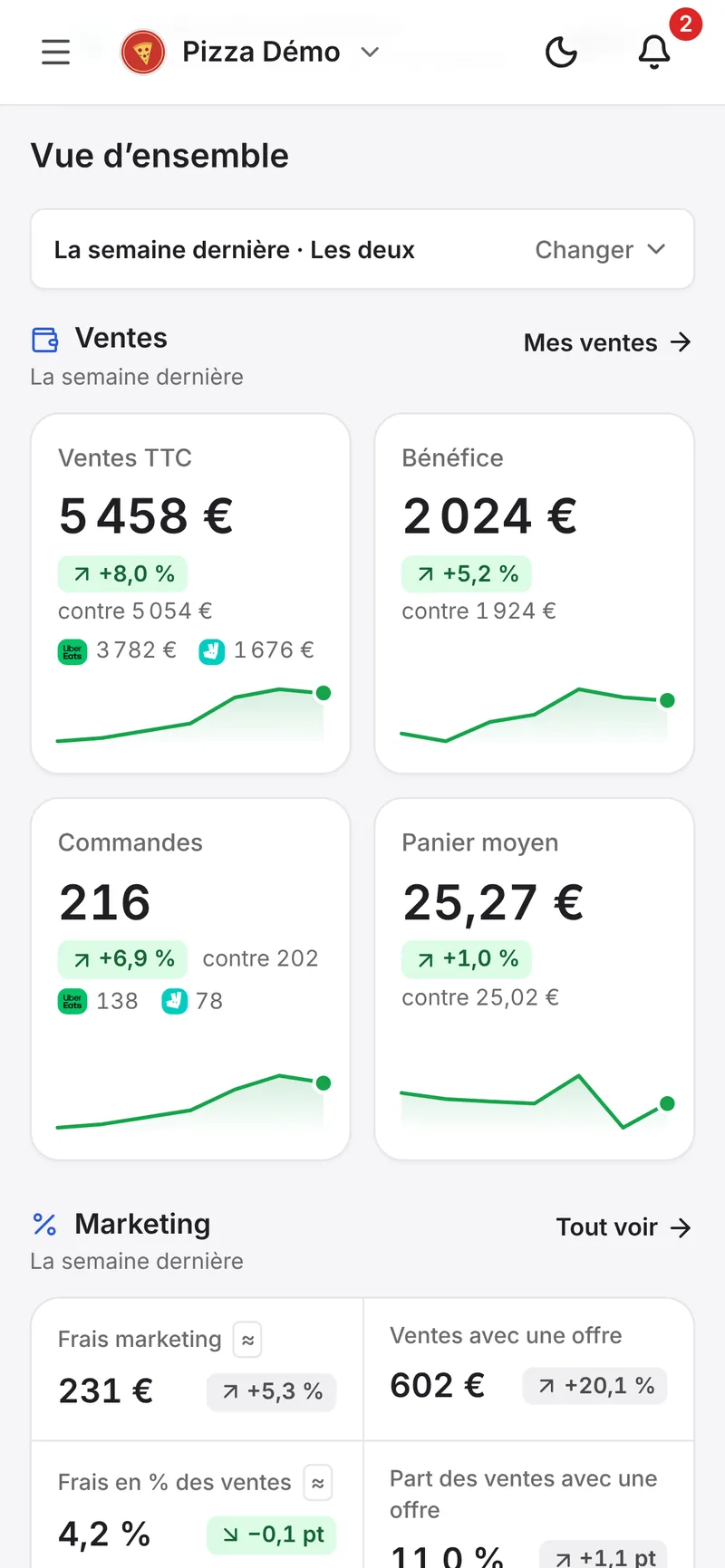
With a second brand, you have twice as many sales, reviews and refunds to keep track of. Deliview brings your Uber Eats and Deliveroo sales together on one screen, with your reviews and the refunds to dispute.
Which mistakes get a virtual brand suspended?
- Reusing the same menu under another name: Deliveroo treats the new establishment as a duplicate account and suspends it.
- Borrowing the name or logo of a well-known chain: Uber can remove a brand that infringes intellectual property rights.
- Cooking somewhere other than the declared restaurant: at Uber Eats, the brand is prepared on your premises, and a move must be notified 7 days in advance.
- Leaving the brand closed mid-service: your customers can no longer find it. Our article on the restaurant closed mid-service explains how to avoid it.
In Deliview
Your Uber Eats and Deliveroo data on one screen
Your sales, your prices against those in your area, your reviews and the refunds to dispute.
Sources
- Conditions générales Uber Eats pour les commerçants (France), modifiées le 10 septembre 2026, Uber, accessed 9 October 2026.
- Restaurants virtuels, Uber, accessed 9 October 2026.
- Devenez partenaire d’Uber Eats, Uber, accessed 9 October 2026.
- Politiques Deliveroo pour les partenaires, Deliveroo, accessed 30 October 2026.
- Conditions générales des partenaires Deliveroo, Deliveroo, accessed 9 October 2026.
- Deliveroo Editions, Deliveroo, accessed 9 October 2026.
- Toilettage dans les destinations et sous-destinations réglementées dans le PLU, Landot & associés, accessed 9 October 2026.
- Plan local d’urbanisme bioclimatique : vers un Paris plus vert et plus solidaire, Ville de Paris, accessed 9 October 2026.
- Règlement du PLU bioclimatique de Paris, tome 1, Ville de Paris, accessed 30 October 2026.
- Formation obligatoire à l’hygiène alimentaire en restauration commerciale, Service Public Entreprendre, accessed 9 October 2026.
- Déclarer la manipulation de denrées alimentaires d’origine animale, Ministère de l’Agriculture, accessed 9 October 2026.
- Dark kitchen et cuisine fantôme : opportunité ou piège pour le restaurateur ?, Extencia, accessed 9 October 2026.


